Healthcare workers who are overworked, underpaid, or worried about your visa status…
This Little-Known NHS Pattern Could Be The Perfect Opportunity For You…
PLUS: How you can leverage it TODAY!
Every autumn the Chancellor of the Exchequer announces the Autumn Budget, during which they may allocate new budgets to public projects that need to be prioritised.
These funding changes are typically spread across government departments and agencies. The NHS is one of the public bodies that regularly gets a fresh injection of funds around this time.
Around the same time of the year, every year for the past four years, NHS organisations have gone on a hiring spree for specific roles.
Coincidence? I think not.
In a couple of minutes you will learn…
- Why this happens
- Why it is relevant to you—especially today
- And how you can leverage it this 2026 to build a better future for you and your family in the UK.
A Big Hole That Needs Filling
In 2021, Health Education England's Digital Readiness Program commissioned a report to understand the challenges faced in the NHS.
They also forecasted how much demand would grow, and what they would need to continue function efficiently over the decade.
This report projected that the NHS would need to hire an additional 32,000 Digital, Data and Technology (DDaT) staff before 2030 to ensure that clinical staff can continue to operate smoothly.
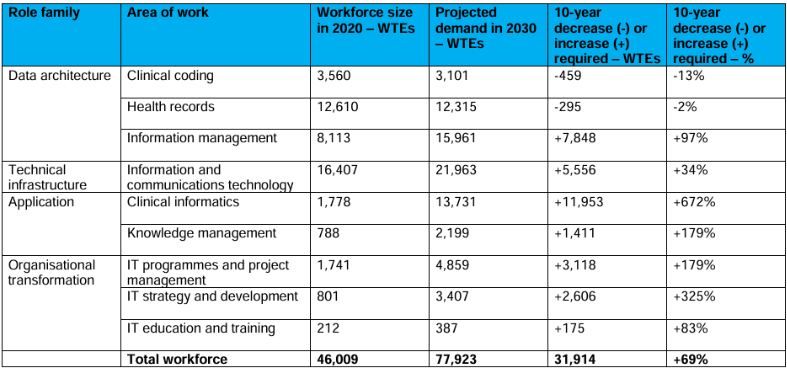
Source: © Health Education England. Data Driven Healthcare in 2030 – Summary Report (2021). Licensed under the Open Government Licence v3.0.
Look at the table above again.
Pay special attention to the recommendations for Information management (+7,848) and Clinical Informatics (+11,953). They are the most relevant to you, and you'll soon see why.
Government Flip-Flopping, An Endemic Need and A Handicapped Effort
The immediate response to the above report was that NHS organisations went on a hiring spree of tech staff after 2021.
Between June and December of 2022, there were an average of 1360 digital technology jobs posted by the NHS, thanks to the report and the need to recover from COVID-19 pressures.
By 2024, even when operations had stabilised, NHS organisations were still posting 710 new job opportunities for DDaT roles.
But then sometime in 2025, the government began to change its tone.
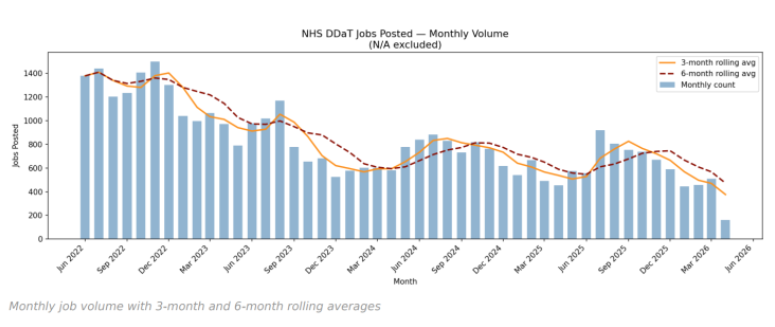
[ Image: James Rawlinson (2026), The NHS DDaT Jobs Market is in Freefall — and the 10 Year Plan Doesn't Add Up, LinkedIn. Data based on NHS Jobs postings analysis. ]
It started saying it would prefer to train clinical staff on how to process data and do most of the functions that DDaT officers would typically carry out.
As if the workloads of Doctors and Nurses were not already too cumbersome.
And, of course, there is a reason behind this decision: MONEY.
The government is always looking for where they can cut funds, so they can re-allocate them to something else. Such is the nature of governments and politicians.
They cut from one department's budget, redirect the same fund to a different project, and then make a big announcement about the new 'investment', for a loud 'hurrah!' And everyone is happy.
They, however, could not possibly cut from the budget for hiring clinical staff—that would be political suicide!
But, for admin staff who work in the background—nobody sees them—that's safe to cut. Doesn't matter that they're the ones who make everything run smoothly. Afterall, who would know?
If it were up to the government, they would slice open the heads of every clinical staff and implant the ability to operate data management systems, so they can free up all that money for flashier projects.
But this is not a problem that you wish away. Doctors and Nurses are already swamped with too much work, as you already know.
And that is why, despite the budget cuts and the government's flip-flopping, NHS organisations stubbornly continue to hire new people to fill those Digital Technology roles.
Over the last year, NHS organisations have posted an average of 621 new DDaT jobs per month.
The guys actually responsible for keeping the system running daily know why those roles are needed; for them, service delivery, and not political expediency, is the greatest priority.
Get Ready for the 2026 Autumn Spike
Every year, for the past four years, the NHS has hired its highest number of DDaT staff.
This pattern repeated last year— even after the government announced its policy shift.
There are two main reasons NHS organisations continue to hire Tech staff during this period:
- The autumn budget typically announces new allocations for technological operations. Which means more money for the department to operate with for their needs—including hiring.
- Autumn is just before winter, which is when the pressure on the UK healthcare system typically reaches its yearly peak.
Administrators know that while they might get away with playing around during spring and summer, they must prepare for winter, and so they hire ahead in preparation.
And that is why you can expect another spike in NHS tech hires starting from August this year, and through November.
An Opportunity You Are Perfectly Positioned to Seize
Do you remember what roles I asked you to keep in mind earlier?
Clinical Informatics and Data/Information Management roles are some of the most vital roles for the NHS' DDaT operations.
Here's a summary of the responsibilities of these functions:
Clinical Informatics: These roles involve ensuring that digital systems—such as Electronic Patient Records (EPR)—are designed and used safely to improve patient outcomes and frontline efficiency.
Clinical informatics staff help shape digital systems—like patient records and ward tools—so they actually fit how care is delivered on the ground. Because they understand real clinical work, they use that experience alongside data to fix inefficiencies, reduce delays, and make patient care smoother and safer.
The core skills required for this role are clinical expertise, information analysis and technical literacy.
Information Management: They organise how patient data is stored and connected so clinicians can quickly access accurate information when making decisions.
It helps to understand how care is delivered in practice, ensuring that systems reflect real clinical workflows and support safer, more efficient patient care. The core skills required for this role are data modeling, information management (IRMG), technical literacy and clinical literacy.
Dear healthcare worker…
- Whether you're a registered nurse looking for a job that affords you more time for your family,
- Or a healthcare assistant desiring a better paying job and thinking that you would need to leave healthcare entirely and start all over again,
- Or an auxiliary nurse who needs a job that will sponsor your visa, and feeling hopeless.
Whichever you may be, getting into tech does not have to mean discarding all your clinical training.
All those years in school and working round the clock to care for patients have prepared you for these jobs that you possess the rare characteristics to leverage.
How To Leverage This Opportunity
NHS organisations process massive amounts of data daily.
They need people who can crunch that data and produce actionable guidance that simplify the workflows for clinical staff, harmonise patient data across units, and help reduce wait times for people in need of care.
This is typically what a data analyst would do for them.
But this is healthcare, and not just another tech company, and that's why the NHS prefers to hire people that are already clinically literate, and even better if they have done clinical work before.
And that is where you have the edge over a purely tech person looking to get into these Healthcare Analyst roles!
It is much easier for you to learn to do what they do, than for them to acquire the clinical experience that you have gained through years of studying in school and working within the system to care for patients.
Unlike a tech guy from outside the system, you do not need to learn NHS systems and code like HES or GDPPR or SNOMED CT or ICD 10.
You already know Caldicott Principles like the back of your hand, as well as OPCS and the EPR.
To prepare yourself for this role, you only need a couple of months to master the common tech tools for the job.
But Is Healthcare Analytics A Better Working Life Than Your Present Job?
A career in healthcare analytics is not for everyone.
Firstly, because it is work, and no job is a walk in the park—least of all in the NHS.
Secondly, to make this transition, you will need to learn new skills—tech skills. If tech is not your friend, or learning new things is not your cup of tea, then you should probably hesitate before joining.
Mastering this skill will require you to spend some of your free time learning and practicing for the next few weeks and months. It will frustrate you at times.
If you do get a job, it will be a new field for you; a departure from clinical work that you have become used to for 10 or 15 years. It will feel strange, and you will feel like an imposter sometimes.
If you don't like trying new things, or taking any sort of risk, then this is not for you.
But, if you've read all of that, and you're saying to me, "I understand, but I also want to weigh the potential benefits," here you go:
- Most Tech jobs in the NHS are hybrid or remote-friendly, even for centres outside London.
So, if spending more time with your family, or the ability to experience other things is a priority for you in this season of your life, then you should consider this. (Registered nurses fit this bill perfectly.) - Most Tech roles, even for entry level jobs, start at the NHS AfC Band 5 and higher.
Band 5 roles pay between £32,000-£39,000. If you're currently working as a healthcare assistant or an auxiliary nurse, this means better pay for you.
Band 5 roles also typically come with visa sponsorship for immigrants, so if that's what's most pressing on your mind, it would not hurt to open this door for yourself.
Some of the job titles in this role:
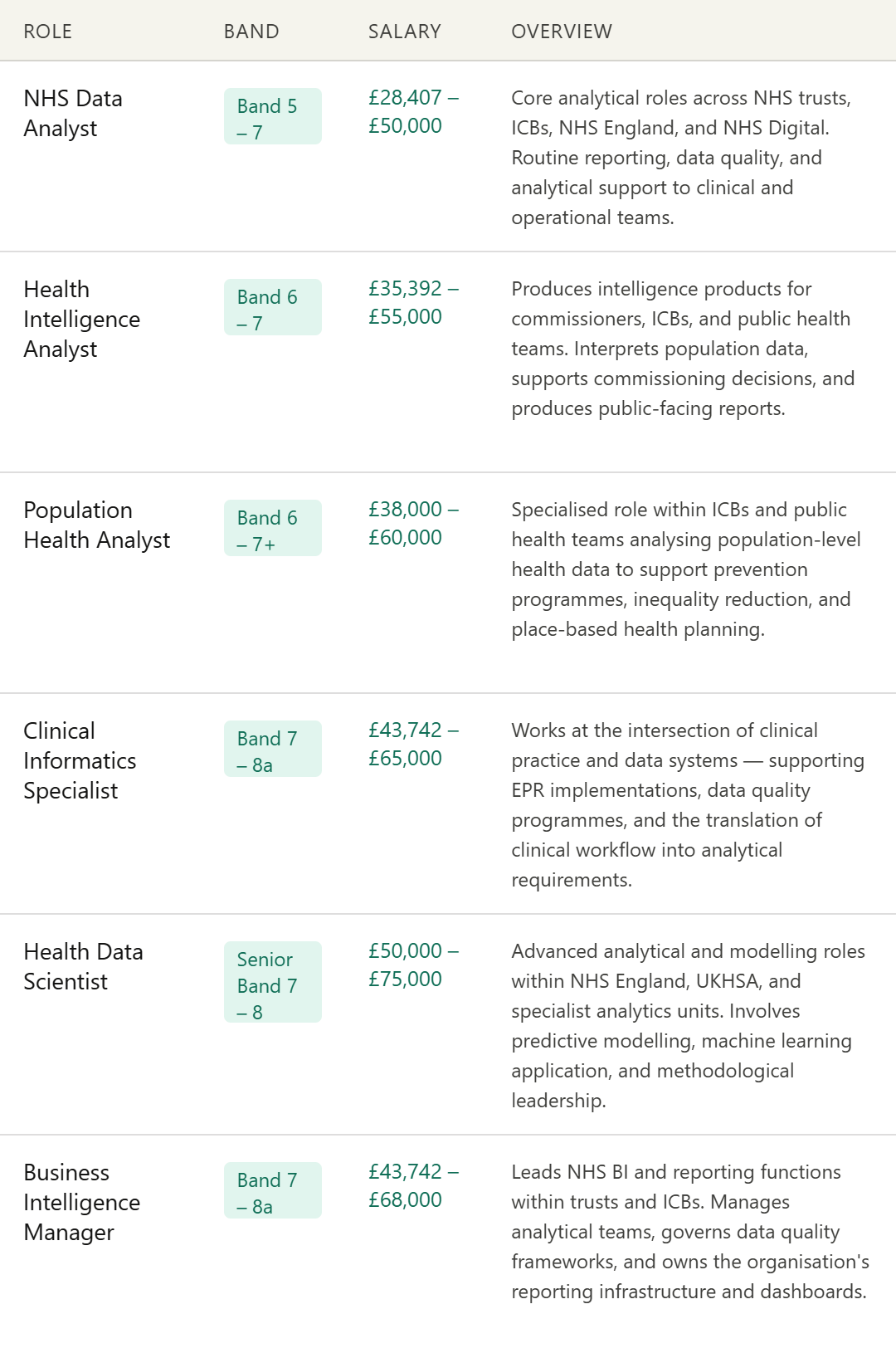
[ Image: Job titles in Healthcare Analytics / Clinical Informatics ]
How Tritek Can Help You Today
This Saturday, May 2, we start a 12-week course to train and prepare people like you to acquire the data analytics skills required to be employed into these roles.
Over the past nine years, 3,000 people who have passed through our tech training have now transitioned into tech roles.
Some of them now work across organisations like, NHS England, UKHSA, Integrated Care Board, NHS Digital, NHS Trusts, Public Health England successor bodies, NICE, NHS Wales, as well as Private hospitals & healthcare groups, and Health analytics consultancies.
From Administrative Stagnation to PMO Lead in NHS: My 12-Week Transformation
"For a long time, I felt like I was hitting a ceiling. I was working in a traditional administrative role, doing the same things every day, and honestly? I felt stuck. I knew I had more to offer, but I didn't have the technical roadmap or the 'industry language' to break into the high-level roles I saw others landing.
Then I found Tritek Academy.
I didn't just want another certificate; I wanted a career shift. From Day 1, the experience was different. This wasn't just theory—it was like being thrown into a real-world project environment. I was no longer just 'learning' about Project Management; I was living it.
The most intense part was the 12-week stretch. Balancing the project work, the mentorship sessions, and the JobAssist program was a challenge, but it was exactly the pressure I needed to grow. The mentors didn't just teach me how to manage a project; they taught me how to lead a team and speak with the confidence of an expert.
Exactly 12 weeks after I started, the breakthrough happened.
I am so proud to share that I have officially secured a role as PMO Lead. Looking back at where I was just three months ago, the difference is night and day. I went from managing spreadsheets to leading a Project Management Office.
If you're sitting where I was—feeling like you've reached your limit but knowing there's more—take the leap. The structure, the support, and the real-world projects at Tritek are the real deal. It's not just a course; it's a career relaunch.
My name is Tosin, and this is my Tritek success story."
Hear from our alumni
Claudia
Damola
Adeshina
Ayotunde
Not only are we experienced in equipping people with tech skills, our training has helped countless others before you to scale through the NHS Digital hiring process and secure highly-rewarding jobs.
If this is an opportunity you really, really want, there are few places better to train and guide you into your new career.
Only 37
The cohort runs from the start of May to the end of July.
This means that those who would have gone through the training would be perfectly positioned to begin applying for the jobs during the August-November NHS hiring spike.
But for this cohort, we only want to take on 50 candidates.
If you're familiar with our courses, you know that we typically train over 200 people in every cohort. So, why only 50 for this course?
Because we are realistic. We want to ensure that everyone who enrols has a high percentage of certainty that after the training ends in July, the 50 people can get jobs.
By keeping the number so small, we are also ensuring that you get the best attention from your instructors during the training.
13 people have already signed up, so we only have space for 37 more.
If you have been thinking about transitioning into tech, and you currently work in healthcare, this might be the perfect timing for you.
And here's what you will learn during the 12 weeks of the training:
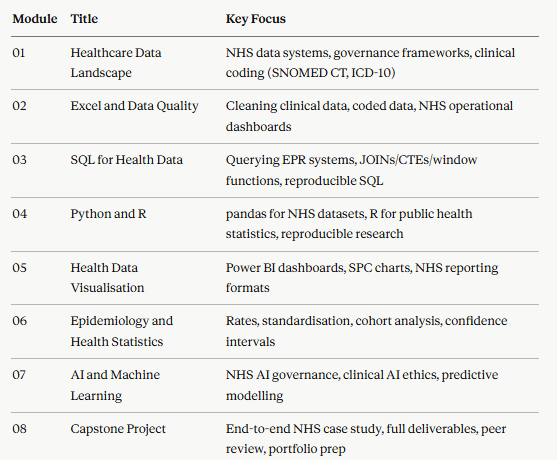
[ Image: 12-week curriculum and tools breakdown ]
…And Now, The Best Parts
You have just seen all the tools you will learn how to use for your future job. But that's just the tip of what you get during this training. Here are the best parts:
- Practical Work Experience: This is the Tritek Special Sauce. As with all our training courses in Tritek, you do not pass through without getting hands-on practice that puts you through real-life situations and conditions you to put the skills you have acquired to use.
Four out of the 12 weeks of the training will be specifically for gaining this work experience that you can also demonstrate on your CV as you apply for jobs.
This way, you can show that you're not only a learner of theory, but also one with work to show for the skill you claim to possess. This gives you another edge on top of your clinical experience. - Insider Tips on What Works to Get into the NHS: Remember those alumni candidates who work/have worked with the NHS in tech roles?
You will get to connect with some of them in our community, and have access to insider tips on how to approach the interview process and scale them.
The training starts on Saturday, May 2, so we're closing enrolment on Friday Night so we can use Friday to onboard everyone before classes start on Saturday.
Will you join the 13 that have taken action?
How Much to Enrol for this Training?
The market rate for a data analytics course that…
- Provides context-specific (NHS & Healthcare) data analytics training
- Gives you live classes with human instructors showing up every week
- Equips you with work experience during the training
- Provides job search support like guidance on how to apply for jobs and interview prep
- Connects you with a community of people in-the-know who can give you tips
Goes for anywhere between £1,500-£3,700 as a legitimate fee.
But I will never ask you to pay that much for this course.
I understand that many reading this are in dire straits in need of a job that provides specific conditions, and as someone who is originally from outside the UK, I know how that can feel.
People that enrolled before now did so for £429, and that is the going fee. It is more than fair for all the value you would be getting.
But, since the time is short, and since this page will be going down on Friday night—whether the cohort fills up or not—you get an even further discount.
If you click the button below right now, you will pay only £399 today.
Can you pay in instalments?
Yes. We support payments through Klarna and ClearPay.
With Klarna you can pay in three instalments, while ClearPay allows you to pay in four instalments.
Frequently Asked Questions
Q: How long is this course?
A: The course runs for 12 weeks with 8 weeks of live virtual training classes, and three weeks for your Internship/Capstone project, and one week for presenting the project.
Q: What support do you provide toward helping me get a job?
A: Candidates get coaching on how to optimise their LinkedIn pages to improve their attractiveness to recruiters, guidance on how to apply for jobs and interview prep sessions.
Q: What is the typical pay band in the NHS for roles that require this skill?
A: Entry level roles with this skillset in the NHS fall within the AfC Band 5, for which the minimum salary is £32,000-£39,000 per annum. If you get a job with a private hospital or health organisation, you could even earn significantly higher with this skill!
Q: Will this help me get a visa-sponsored job?
A: NHS Band 5 roles are typically visa-sponsored for immigrant workers.
Q: My job is busy, how will I attend all the classes?
A: All live classes are recorded, so even if you miss a class due to work, family, or any other reason, you will be able to watch the recording for that class. You will also have access to instructors to ask them questions outside class.
Q: Are your certificates recognised?
A: Certificates issued by Tritek are recognised locally and internationally, as we have a CPD accreditation, and are recognised by the UK government as a registered learning provider (UKRLP).
Q: What should be your tech setup?
A: The minimum tech setup details will be shared during onboarding. A laptop or desktop with a stable internet connection is sufficient to get started.